The Case for Customised Office Cleaning: A Smarter Solution for Modern Hybrid Offices
The shape of office work has shifted dramatically in the past five years. Tuesday-to-Thursday in-office attendance, hot-desking, flexible meeting room bookings, and quarterly all-hands days have replaced the predictable five-day, fixed-desk patterns cleaning contracts were originally designed around. The cleaning industry has been slower to adjust than the workforce itself.
A cookie-cutter contract that schedules the same routine every weeknight regardless of actual occupancy wastes money on quiet days and falls behind on busy ones. Customised office cleaning services rebuild the program around how the building actually gets used — variable headcount, hybrid patterns, and the real wear-points of a modern flexible workspace. This piece walks through what good customisation looks like, what to ask for, and how it pays back over a year.
Why Standard Cleaning Plans Fall Short for Modern Offices
Mismatched Frequency and Actual Use
A standard contract typically deep-cleans every room every night. Modern offices don’t use every room every day — Mondays and Fridays often run at 30% occupancy while Wednesdays hit 90%. Paying for the same cleaning on a Monday as a Wednesday is a straightforward waste that compounds across 52 weeks. The reverse problem is just as common: peak Wednesdays leave bathrooms under-serviced while quiet Fridays get a full clean, nobody is around to use.
Generic Scope That Misses Specific Needs
Off-the-shelf scopes don’t reflect a particular office’s mix. Generic office cleaning services typically deliver the same task list to a creative agency as to a law firm — overlooking the fact that the agency’s whiteboards and prototype rooms have very different needs from the firm’s library and corner offices.
Inflexible Scheduling
Standard contracts lock in fixed shift times. Modern offices increasingly need cleaners who can adapt — early starts before a board meeting, daytime quick-cleans before client visits, or extended weekend deep cleans before a major event. Rigid schedules force facility managers to work around the provider rather than the reverse.
What Customisation Actually Means in Practice
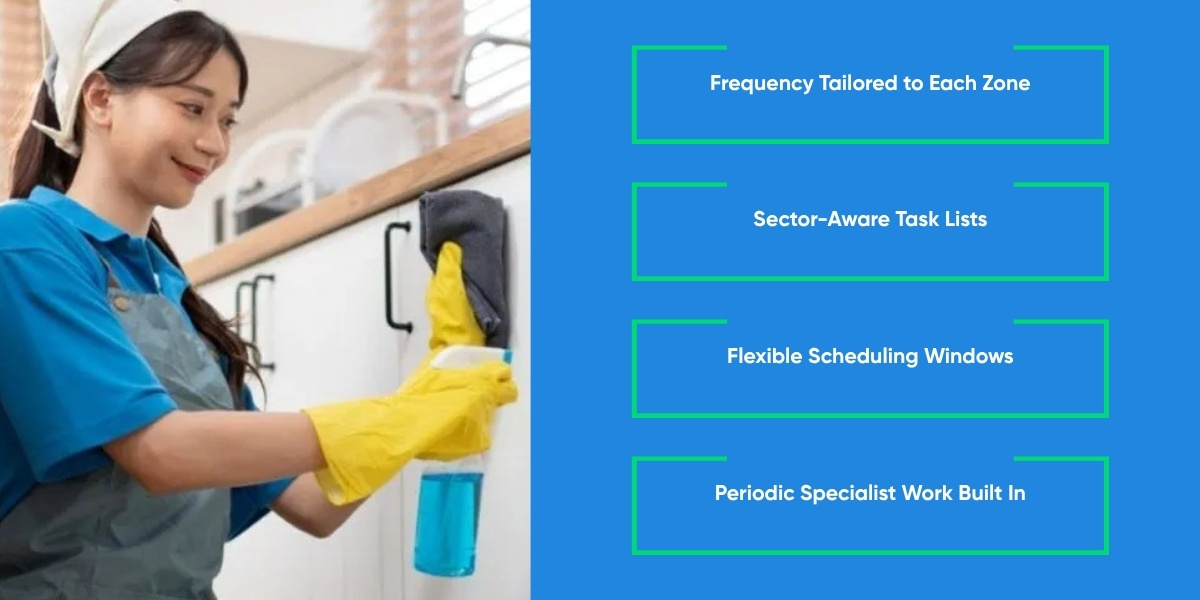
Frequency Tailored to Each Zone
Strong office cleaning services for modern workspaces assign cleaning frequency by occupancy zone. High-use zones like kitchens, main bathrooms, and hot-desk pods get daily attention. Low-use zones like executive offices and training rooms move to twice-weekly with on-demand top-ups before scheduled use. This alone often cuts contract spend by 10 to 20%.
Sector-Aware Task Lists
A finance trading floor needs near-silent cleaning during pre-open hours. A design studio prioritises whiteboard and pinboard care. A medical consulting suite tied to a tower needs hospital-adjacent disinfection standards. Customised scopes capture these realities explicitly rather than burying them in generic clauses.
Flexible Scheduling Windows
Customisation includes shift flexibility — daytime light cleans for client-visit days, after-hours deep work on quieter nights, and on-call response for events. The contract specifies the available windows and notice periods, not just a fixed start time, so the provider can flex with the building rather than against it.
Periodic Specialist Work Built In
Customised programs schedule specialist work — window cleaning, floor cleaning, carpet deep cleans, upholstery refreshes — at intervals that match the actual building rather than a default calendar. Quarterly glass, monthly floors in high-traffic zones, twice-yearly carpets in client-facing areas.
How a Smart Customised Plan Gets Built
Start With Occupancy and Usage Data
Modern offices usually have access tags, meeting room booking data, and visitor logs. Mining this for actual usage patterns gives a cleaning provider a real baseline rather than a guess. Office cleaning Sydney providers worth working with will ask for this data during the scoping phase, not after the contract is already signed.
Walk the Floor Together
A customised plan needs a joint walk-through. The facility manager points out hot zones, pain points, and politics (“the CEO notices fingerprints on her glass partition immediately”); the provider points out efficiency opportunities, equipment options, and scope realism. The contract that results actually reflects the building, not the brochure.
Build in a Review Cadence
A customisation is only as good as its quarterly review. Strong providers like Hope Cleaning Services schedule formal scope reviews every three months, adjusting frequency, scope, and shift patterns as usage patterns shift. Daily office cleaning routines that were right in January often need adjustment by July.
Frequently Asked Questions
How much does a customised plan typically cost compared to a standard contract?
Done well, customisation is cost-neutral or 5 to 15% cheaper than a standard equivalent at the same site. Spend shifts from over-cleaning quiet areas to better-resourced high-impact zones. The savings come from frequency right-sizing, not from cutting corners.
Do all commercial cleaning providers offer real customisation?
Most claim to, but few genuinely deliver it. The test is whether the provider asks detailed scoping questions, requests usage data, and proposes zone-specific frequencies rather than a single uniform schedule. Many commercial cleaning services companies still default to one-size templates with minor tweaks.
How long does it take to set up a customised plan?
A proper customisation takes about three to six weeks from initial walk-through to first shift. That includes data review, scoping, contract sign-off, team allocation, and a soft-launch shadow period. Anyone offering a “customised” plan starting next Monday is selling a standard contract under a new name.
Conclusion
Customisation in office cleaning isn’t a marketing layer — it is the working answer to the question every modern facility manager already faces: how do you keep a space genuinely clean when the way it gets used keeps changing? The answer turns out to be the same shift cleaning has been quietly making in healthcare and warehousing for years: match the work to the reality, not the calendar.
For any facility lead reviewing a contract this quarter, the most useful exercise is to overlay the current cleaning schedule against the building’s actual occupancy data. Wherever those two diverge, there is either money being wasted or quality being lost, and usually both quietly happening at the same time. Hope Cleaning Services in Sydney delivers a genuine, customised approach that closes that gap and keeps closing it as your workplace continues to evolve.