Understanding the Real-World Challenges of Medical Cleaning Compliance in Sydney
Walk into any working hospital or busy GP practice mid-shift, and the cleaning crew is invisible only when they are doing the job right. The moment something slips — a missed wipe-down on a treatment bay — clinical staff notice immediately, and so do auditors who arrive without warning.
For anyone providing healthcare cleaning in Australia, compliance isn’t a paperwork exercise — it is the line between a safe facility and an infection control incident. This piece looks at the challenges of medical cleaning compliance that frontline teams actually wrestle with, where programs typically fall short, and what experienced providers do differently to stay on the right side of audits.
What “Compliance” Actually Means in Medical Cleaning
Australian Standards and State Health Guidelines
Compliance is shaped by AS/NZS 4187, the Australian Guidelines for the Prevention and Control of Infection in Healthcare from the NHMRC, and NSW Ministry of Health directives. Each layer specifies how surfaces are categorised and how often validation must happen.
Infection Prevention and Control Frameworks
Cleaning sits inside a wider Infection Prevention and Control program — colour-coded equipment, defined cleaning sequences, terminal cleans after infectious cases, and documented audits. A cleaner who treats compliance as “do a good job” without understanding IPC will eventually miss something that matters.
Accreditation Audits and What They Look For
Hospitals chase accreditation through bodies like the Australian Council on Healthcare Standards. Auditors review cleaning frequency logs, chemical use records, training certificates, and the physical state of high-touch surfaces. Failed findings often cite cleaning gaps — not because cleaning is the only issue, but because it is the easiest one to evidence.
The Real Challenges That Make Compliance Hard
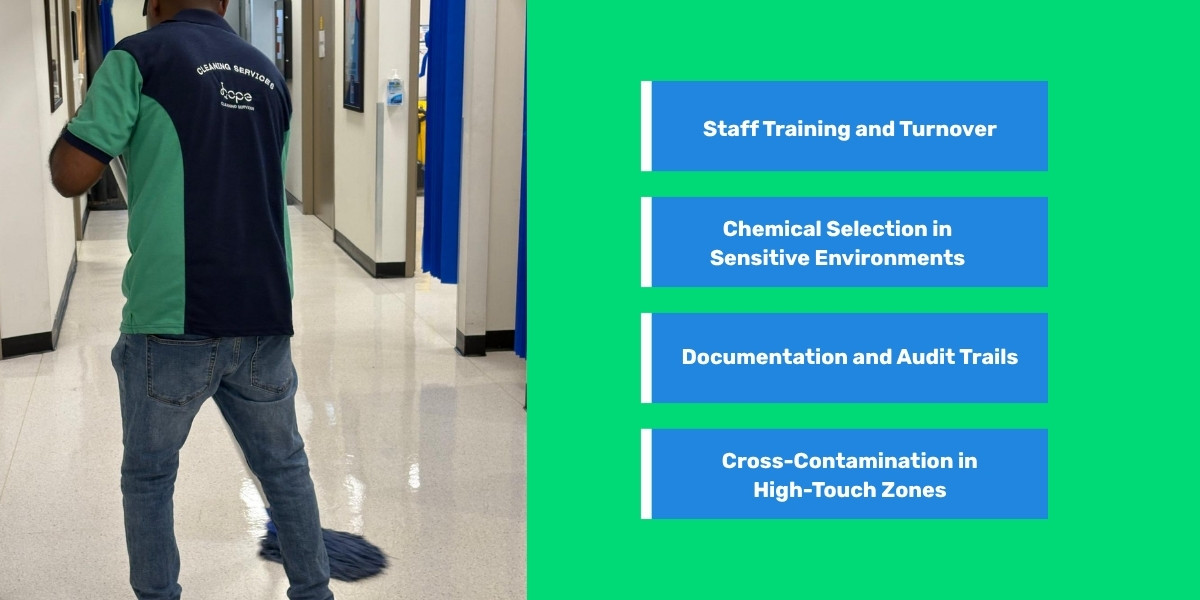
Staff Training and Turnover
The cleaning industry sees high turnover, and healthcare sites need cleaners who know the difference between a clinical wipe and a domestic-grade product, between standard precautions and contact precautions. Properly onboarding a new staff member into a hospital takes weeks of close supervision — and most contracts don’t pay for that runway.
Chemical Selection in Sensitive Environments
Disinfectants approved for clinical use are tightly regulated by the TGA. Picking the wrong product — say, a quat-based cleaner on a surface that needs sodium hypochlorite for C. difficile control — invalidates the clean. Cleaners must know which chemical to use, plus contact times, dilution ratios, and surface compatibility.
Documentation and Audit Trails
Every clean needs a record. Many of the medical cleaning challenges that show up at audit time are documentation gaps, not actual cleaning failures. Missing signatures on terminal-clean checklists, undated theatre logs, or inconsistent inspection sheets all create the same problem on paper: unprovable compliance.
Cross-Contamination in High-Touch Zones
Door handles, IV poles, bed rails, nurse-station keyboards, lift buttons — these surfaces drive nosocomial infections. The challenge isn’t knowing they matter; it is maintaining the discipline to clean them at the right frequency across hundreds of micro-tasks per shift.
Where Medical Cleaning Programs Commonly Go Wrong
Reactive Cleaning Replaces Scheduled Routine
When a ward gets busy, scheduled cleans get pushed back. A few of those slips per week compound into a noticeable drop in environmental hygiene scores within a month. Cleaning routines need ringfencing in clinical environments, not flexibility.
Colour-Coded Systems Stop Being Followed
Red for bathrooms, blue for general, green for kitchens, yellow for isolation — the system only works if it is followed every single time. The moment a cleaner uses a blue cloth in a toilet, the chain breaks. Spot-checks pick this up; complacency is what allows it to start.
Soft Furnishings and Carpets Get Forgotten
Waiting room chairs, reception carpets, privacy curtains, and examination couches — none stay clinically acceptable on a wipe-down schedule alone. Periodic deep work like steam-cleaning, carpet cleaning, and curtain replacement is where many sites quietly drift out of compliance. Auditors notice, even when patients don’t.
How Sydney Providers Hold the Line on Compliance
Tiered Frequency Aligned to Zone Risk
Strong medical cleaning services classify every area by risk level — Class A (high-risk, like operating theatres) through Class D (administrative) — and align cleaning frequency, technique, and chemicals to that classification. This isn’t optional, but it surprises many facility managers how often it isn’t fully implemented in practice.
Built-In Training Refreshers and Toolbox Talks
Providers offering compliant medical cleaning Sydney programs run regular toolbox talks, supplier-led product refreshers, and short scenario-based training. New regulations and post-incident reviews feed back into the training cycle. Hope Cleaning Services and similar long-standing local providers build this into contract pricing rather than treating it as an add-on.
Independent Auditing and Reporting
External validation matters. Whether through ATP swab testing, UV-marker spot checks, or third-party audits, the best programs measure their own work rather than relying on visual inspection alone. The contrast with general commercial cleaning services is sharp here — healthcare contracts demand evidence-grade reporting, not just signed-off checklists.
Frequently Asked Questions
Do GP clinics need the same level of cleaning compliance as hospitals?
The clinical risk in a GP setting is lower than in an operating theatre, but the same standards apply to surfaces patients actually touch — consult rooms, treatment areas, bathrooms. Smaller practices usually work to a scaled-down version of the same IPC framework rather than a separate one.
How often should medical cleaning audits happen?
Internal audits typically happen monthly, with quarterly deeper reviews and an annual external assessment for accredited facilities. High-risk areas like theatres and ICUs are usually audited weekly through a combination of visual checks and surface sampling.
What is the most common cause of a failed compliance audit?
Documentation gaps and inconsistent application of colour-coded systems lead to most failure reports. Actual cleaning quality is often acceptable on the day, but the audit trail showing it was consistently delivered is missing or incomplete.
Conclusion
Medical cleaning compliance is hard work — not because the standards are unclear, but because staffing, scheduling, and clinical pressure make them genuinely difficult to maintain. Facilities that get it right treat their cleaning teams as a clinical resource, not a back-office utility, and they invest in training and validation accordingly, with support from professional providers like Hope Cleaning Services.
For providers and facility managers working in this space, the takeaway is simple. Compliance is built shift by shift, in the small decisions made by individual cleaners on individual surfaces. Get those decisions right consistently, document the work properly, and the audits start to feel less like a threat and more like a confirmation.