A Complete Guide to Practical Green Cleaning Strategies for Modern Offices
Sustainability has shifted from a marketing tick-box to an operational standard in Sydney’s office market. Tenant fit-out briefs, NABERS ratings, and Green Star certifications all increasingly factor in how a building is cleaned and what products end up in the air, on the carpets, and down the drains. The era of “we use the cheap stuff and open a window” is genuinely over for any serious commercial tenant.
This guide breaks down what green cleaning actually involves at the office level — the chemicals, the equipment, the waste, the people. It covers the green cleaning strategies for offices that produce measurable change, and the easy traps to avoid. Whether you manage an open-plan startup space in Surry Hills or a multi-floor head office in North Sydney, the same principles apply.
What Green Cleaning Actually Looks Like in an Office Setting
Beyond Green Marketing Claims
A product labelled “eco-friendly” or “natural” means very little on its own. Independent certifications matter — GECA (Good Environmental Choice Australia), Ecologo, Green Seal, or equivalent. Real green cleaning in offices requires traceable certifications across the chemical, paper, and equipment lists, not just one or two hero items at reception.
The Australian Frameworks Worth Knowing
Green Star, NABERS Indoor Environment, and the Better Buildings Partnership Cleaning Accord shape how serious commercial spaces in Sydney approach this. Cleaning contracts in certified buildings often have to align with these frameworks contractually, so your provider should be able to talk fluently about which one applies to your site.
Where Most Offices Realistically Start
Few offices switch to a fully green program overnight. Most start with the highest-impact wins: replacing aerosols with concentrates, swapping general-purpose cleaners for certified products, and moving to colour-coded microfibre systems. From that base, the deeper strategies stack on naturally over the following quarters.
The Five Key Shifts for Effective Green Office Cleaning
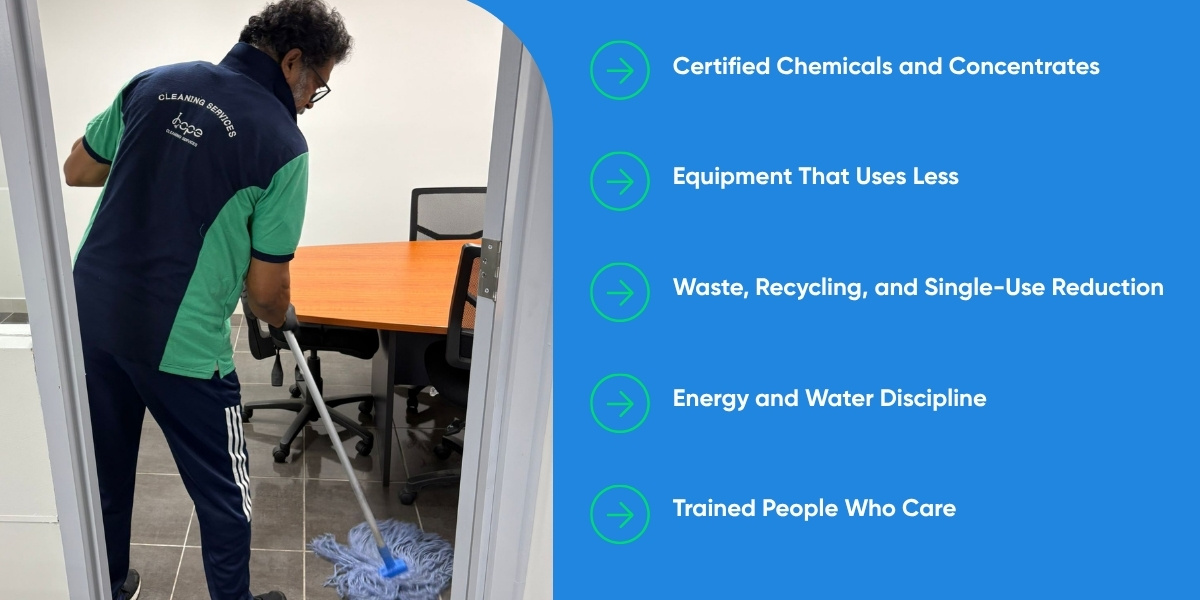
Certified Chemicals and Concentrates
Concentrates with proper dilution control reduce plastic packaging by up to 80%, cut transport emissions, and lower in-air VOC exposure for occupants. Pair certified concentrates with calibrated dosing units so cleaners actually use the right ratios — over-dilution wastes product, and under-dilution leaves residues on shared surfaces.
Equipment That Uses Less
HEPA-filter vacuums improve indoor air quality and trap fine particulates that older vacuums recirculate. Microfibre cloths use up to 90% less chemical than cotton equivalents and last hundreds of wash cycles. Low-moisture carpet extraction machines use a fraction of the water of older models and dry far faster.
Waste, Recycling, and Single-Use Reduction
Track what actually ends up in the landfill from your cleaning program. Paper towel volumes, bin liner replacements, mop head disposals, and chemical container waste all add up faster than most facility managers realise. Switching to washable microfibre, slim-line liners, and refill systems often cuts cleaning waste by half within a single quarter.
Energy and Water Discipline
Cleaning schedules influence building energy use more than people think. Daytime cleaning cuts after-hours HVAC and lighting demand. Spot-cleaning carpets between deep cleans reduces water consumption. Encouraging cleaners to use cold water where the chemistry allows trims hot water heating costs meaningfully across a year.
Trained People Who Care
All the certified products in the world don’t help if cleaners aren’t trained on dilution, sequence, and waste segregation. Strong commercial green cleaning programs run quarterly refreshers, post-incident reviews, and short scenario-based training. The cleaners on the floor are the ones who turn strategy into actual environmental outcomes.
Putting the Strategies to Work
Start With a Quick Cleaning Audit
Before changing products, audit what the current program actually uses — chemical SKUs, paper products, equipment age, waste streams. Most offices find at least three quick wins in the first walk-through. Office cleaning services providers like Hope Cleaning Services typically offer this audit as part of a contract review at no additional cost.
Phase Changes Rather Than Switching Overnight
A wholesale switch creates resistance and operational issues. Phase the rollout: concentrates and certified products first, then microfibre and equipment, then waste reduction, then training. Track measurable indicators — chemical spend per square metre, waste tonnage, indoor air quality complaints — so you can show the impact at quarterly reviews.
Frequently Asked Questions
How much does green cleaning typically cost compared to standard?
Initial transition costs can be 5 to 15% higher, but most offices break even within 12 to 18 months through reduced chemical volumes, less waste removal, and longer equipment life. Properly run green commercial cleaning programs often end up cheaper than the conventional setup they replaced.
Can existing cleaning teams switch to a green program?
Yes, with training. Most experienced cleaners adapt to certified products and microfibre systems within a few weeks. The harder shift is mindset — moving from “more product equals cleaner” to “the right product applied properly is cleaner.” Refresher training fixes this faster than new hiring.
Does green cleaning cover specialised work like carpet cleaning?
Absolutely. Green-certified carpet cleaning chemistry exists across hot water extraction, encapsulation, and low-moisture methods. The choice depends on carpet type and traffic level. Modern commercial cleaning service providers stock multiple green-certified carpet systems and pick based on the floor, not on what happens to be on the truck.
Conclusion
Green cleaning is not a single decision; it is a stack of operational choices that compound over time. While individual changes may seem minor, they collectively improve occupant comfort and certification scores. Successful offices treat cleaning as a key part of their environmental strategy rather than a cost to be squeezed.
For any office manager weighing this move, the most useful first step is an honest baseline audit. Once you understand your current impact, the strategies above layer on naturally. The result—cleaner air, less waste, and a healthier workplace—speaks for itself. Partnering with Hope Cleaning Services for an initial site audit provides the evidence-based starting point needed to begin your journey toward a more sustainable, efficient workspace.